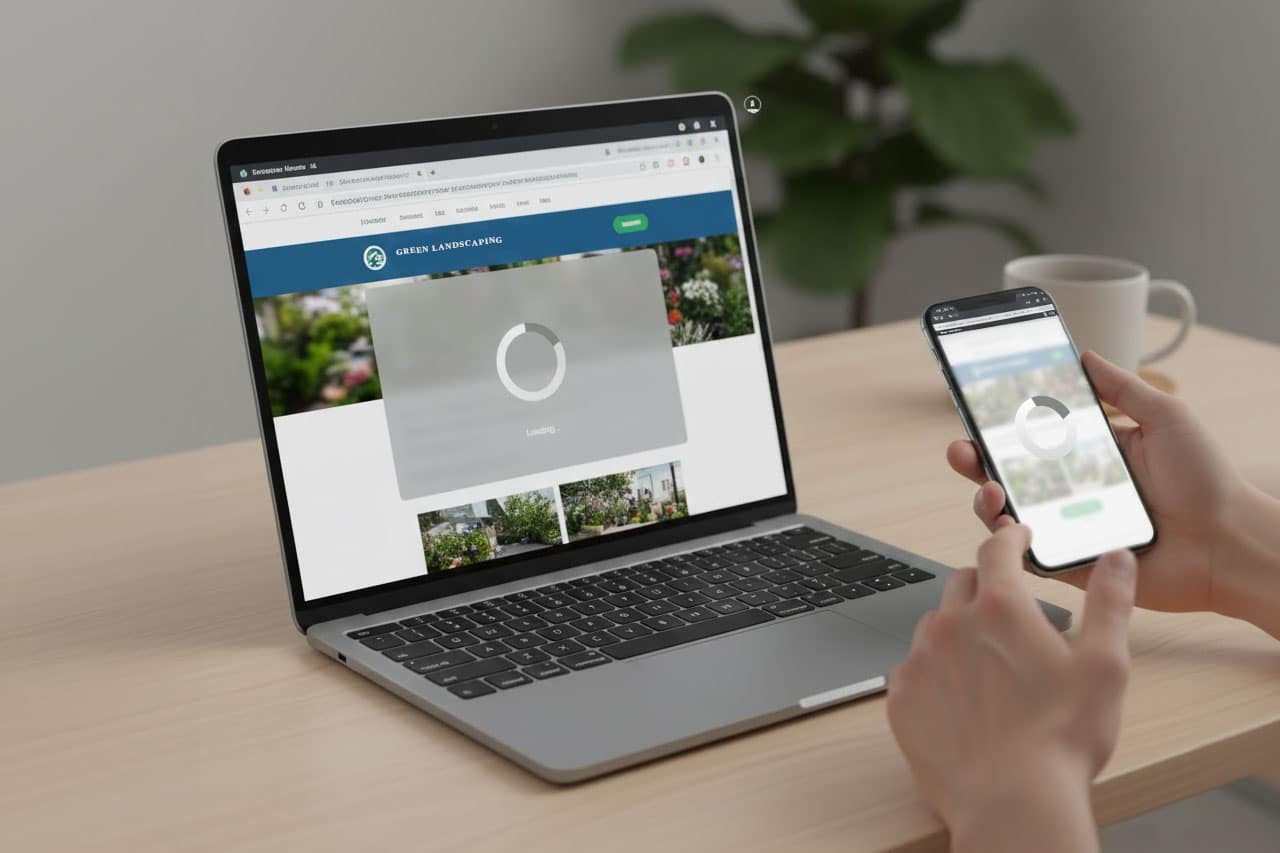
A slow website acts as a barrier between your green industry business and potential clients who expect instant information. When a homeowner clicks on your site to request a lawn care quote or view your portfolio, every second of delay increases the likelihood they will hit the back button and call a competitor instead.
In the green industry, high-resolution project photos and complex booking widgets are often the main culprits behind sluggish performance. Fixing these technical bottlenecks is not just about user experience; it is also a critical factor for your search engine rankings. Search engines prioritize fast-loading sites because they provide a better experience for the user. By optimizing your website for speed, you ensure that your digital storefront is as professional and efficient as the crews you send out into the field.
Why does website speed matter for green industry business owners?
In the modern digital landscape, speed is synonymous with reliability. If your website takes more than three seconds to load, you could be losing over half of your mobile traffic. For landscaping and lawn care companies, a large portion of your leads comes from people browsing on their phones while looking at their yards. If your site stalls, they assume your business might be just as slow to respond to their service request.
Beyond the first impression, site speed is a direct ranking factor for Google. A fast website helps you climb the search results, making it easier for new clients to find you without you having to pay for every click. Speed also impacts your conversion rate. A smooth, fast-loading site makes the transition from “just looking” to “requesting a quote” seamless for the property owner.
Are high-resolution gallery images slowing you down?
As a landscaping professional, you want to show off your best work. High-resolution photos of lush lawns, intricate hardscapes, and vibrant gardens are essential for building trust. However, these large image files are often the primary reason a green industry website becomes slow.
When you upload a photo directly from a modern smartphone or a professional camera, the file size is often much larger than what is needed for a web browser. These “heavy” images take a long time to download, especially on cellular data. To fix this, you must compress your images before uploading them. Tools exist that can shrink the file size by 70% or more without any visible loss in quality. Switching to modern formats like WebP rather than standard JPEGs can also significantly trim the fat from your loading times.
How do unoptimized plugins and widgets impact performance?
Many green industry sites use third-party plugins for things like weather widgets, specialized booking calendars, or social media feeds. While these features add functionality, they also add “requests” to your server. Every time a page loads, your site has to talk to other servers to pull in that data.
If you have too many active plugins, your website has to work overtime just to display a single page. It is important to audit your site and remove any tools that are not strictly necessary for the customer journey. For the tools you do keep, ensure they are updated regularly. Outdated code is often inefficient and can create significant lag or even security vulnerabilities.
Is your hosting provider the hidden bottleneck?
Sometimes the problem isn’t what is on your website, but where your website lives. Choosing the cheapest hosting option often means your site is sharing a server with thousands of other businesses. This is known as shared hosting, and it can lead to “noisy neighbor” syndrome. If another site on your server gets a spike in traffic, your site might slow to a crawl.
Investing in high-quality, managed hosting specifically optimized for your platform can make a world of difference. Premium hosts offer better server technology and content delivery networks (CDNs). A CDN stores copies of your site in various locations across the country, so a homeowner in your local area can pull the data from a nearby server rather than one halfway across the continent.
What technical “under the hood” fixes should you consider?
There are several technical adjustments that can yield massive improvements in speed. While these sound complex, they are standard practices for high-performing service websites.
- Browser Caching: This tells a returning visitor’s browser to “remember” certain parts of your site so they don’t have to download the whole thing again on their second visit.
- Minification of Code: This process removes unnecessary characters from your site’s HTML, CSS, and JavaScript. It makes the files smaller and easier for browsers to read quickly.
- Eliminating Render-Blocking Resources: Sometimes, a site tries to load a heavy script before it shows the text or images. Rearranging the load order ensures the user sees the content they want immediately while the complex scripts finish in the background.
A fast website is like a well-tuned mower. It might look the same on the outside, but it gets the job done much more efficiently and saves you a lot of frustration in the long run.
How can you test your current website speed?
Before you start making changes, you need a baseline. There are several professional tools you can use to see how your site is performing. Google PageSpeed Insights is a great starting point because it tells you exactly how the world’s largest search engine views your site.
Look for your “Time to First Byte” (TTFB) and your “Largest Contentful Paint” (LCP). These metrics tell you how fast your server responds and how long it takes for the main content of your page to become visible. If your scores are in the red or yellow, it is time to take action. Regular testing ensures that as you add new blog posts or project photos, you aren’t accidentally dragging your performance back down.
Get a Faster Website with Lawn Launch Digital
You shouldn’t have to be a computer expert to have a website that works as hard as you do. At Lawn Launch Digital, we know what it feels like to be frustrated with marketing and technology that doesn’t deliver results. That is why we built a system based on over 27 years of experience, not on the latest fads. We have helped hundreds of businesses like yours succeed by focusing on what truly works, from site speed to lead generation.
We understand the unique challenges of the green industry and serve business owners in your region and nearby areas. We take the technical burden off your shoulders by optimizing your digital presence for speed, security, and conversions. Our goal is to make sure your website is an asset that generates revenue, not a slow-loading liability.
Give us a call today at (225) 293-6465
Recent Articles

How to Use Google Ads to Grow Your Landscaping Business

How to Rank Higher on Google Local Services for Landscapers